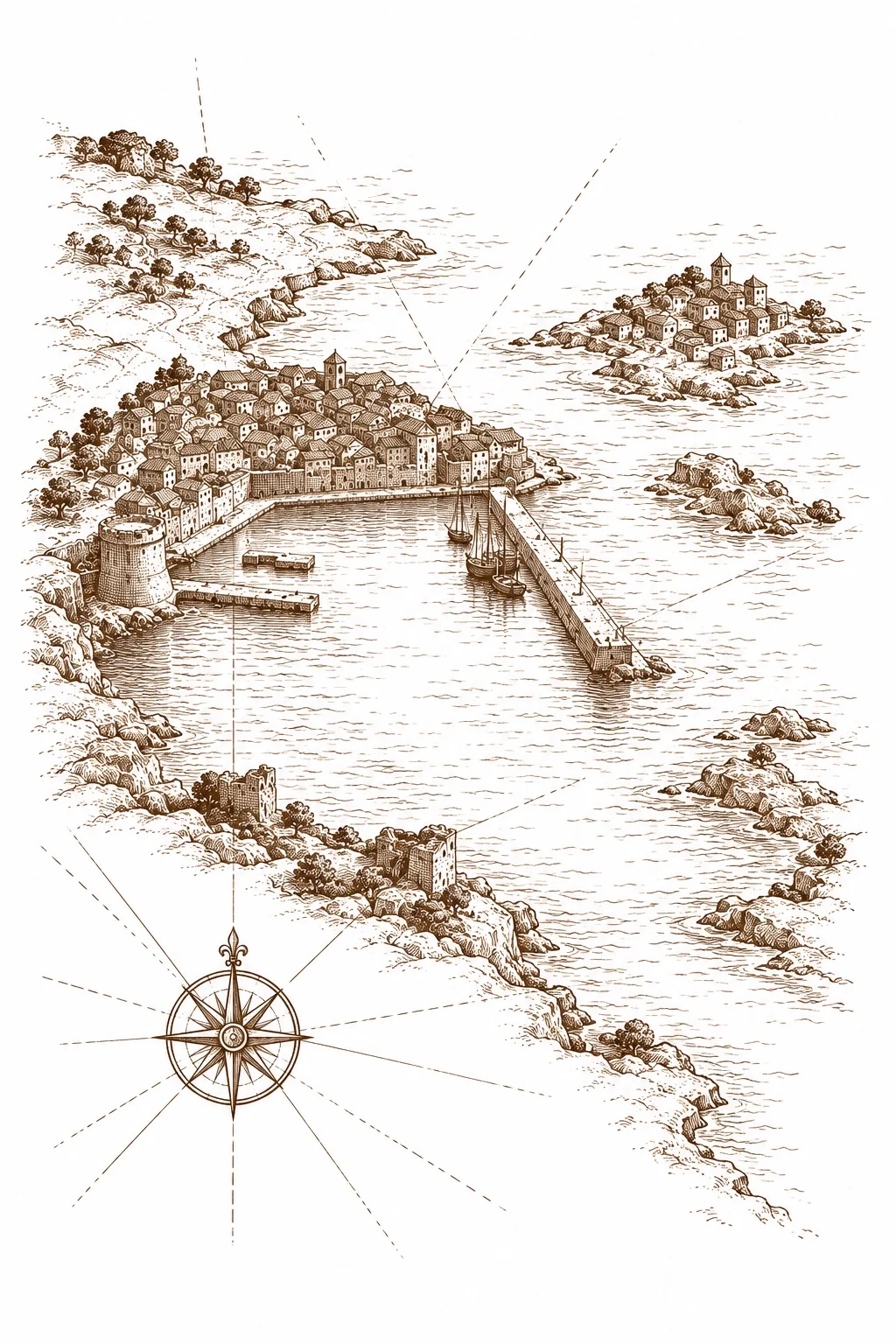
The mine came in under the Post of Aragon a little before the noon bell, and the first that Brother Anzo knew of it was the water in the cup.
He had set the cup on the drumhead of a broken cask, to drink when the digging let him, and was watching the surface of the water when it shivered. Not from any wind. The air lay dead in the ditch, flat with the cold stink of turned earth and old smoke. The water shivered a second time, and rings ran out across it, small and perfect, the way they had run across the font at home when he was a boy and a fly had touched it. They are under us again. He set down his mattock and put his ear to the wall of raw dirt, as the German miners had taught him. The sound was there, far off and patient: the chock, chock, chock of picks in the dark, coming toward him through the body of the earth.
"Brother Loys," he said. He did not shout. A man did not shout under a mine. "Fetch Manuel. And tell the bailiff they have found the countergallery."
The young knight was beside him in a breath, mud to the elbows, his surcoat so filthed that the white cross on it had gone the color of the ditch. A Provencal, four-and-twenty and new-professed, sent down to the Post of Aragon two weeks past because the men who should have held it were dead. The wall went by nations, every langue its post. Aragon here, England beside it, then Provence and Italy and Germany down the line to the sea. The musters had a dry phrase for the sum of them, the brothers who are found at Rhodes. To a man who could hear it, that said how many were not. He had good hands and he did not weep, and Anzo had come to think well of him. In the sixth month of the siege of Rhodes that was as much as one brother could give another.
"How near?" said Loys.
"Near enough that we will hear them break through before we hear the bell for it." Anzo took up the mattock again. "Go."
Forty years at this trade, and he had never grown used to the mine. A man could meet a Turk on the wall and answer him with the sword. That was clean. That was the trade he had sworn to. The mine was the ground you stood on turning traitor. Somewhere beneath his boots other men filled the belly of the earth with barrels. When they lit it, the wall you had bled for went up like a wave and came down as a hill. Buried in it were brothers who had done nothing but stand where they were told to stand.
They had been at it three months, the Turk and the Order both. Two blind companies of moles working toward each other in the dark, under Aragon and under England and under Provence. Martinengo, the Brescian, had spoiled the Turk fifty-five of his galleries by cutting in on them from inside the foundations of the wall. Brother Bosio had fetched him out of Candia in the spring for that. The earth between the two towns was honeycombed. A man could put his ear to the ground anywhere along the terreplein and hear his death being dug. Twice the Order had broken into the enemy's gallery and fought there in the black, by the light of a single lamp, with knives, because there was no room to draw a sword. Twice they had timbered up a countermine of their own and blown the Turk's diggers to Hell with a jar of powder set against the shared wall.
And both times God had chosen the ground and the hour. Anzo crossed himself with a muddy thumb. The powder did what the powder did. Whether it did it under this wall or another, on this day or the next, that was in the gift of God, who does nothing rashly nor in vain, and keeps His own in such perils.
Manuel came, an old Rhodiot Greek with a dish of dried peas, and Loys behind him carrying the drum. He set the dish on the drumhead and watched the peas dance, and put his fingers to them, and said a number, and said a direction. Anzo believed him. The Greek had been right eleven times and wrong none.
"How long?" Loys asked him.
Manuel held up a hand and closed it. "Before the bell."
They set the countercharge where he said, and timbered it, and tamped it, and ran the fuse back along the gallery through the dark. Anzo said the words over it that his own serjeant-master had said forty years ago, im Namen der Dreifaltigkeit, in the name of the Trinity, and lit it. The wall bucked. The dust came out of the gallery mouth in a fist, and somewhere under the Post of Aragon a company of the Sultan's diggers stopped their picking.
That was the last mine they broke. God had let them break it. God did not let them break the next.
The next was the great one, the one the Turk had been three weeks bringing up under the fausse-braye, the low outer wall. It went off days later, a little after the noon bell, when the trumpets sounded. It took a length of the outer wall the height of six men and threw it down into the ditch. The stones went the way the sea takes a heap of sand a boy has piled, all at once and slow at the same time. Anzo saw a whole facing of dressed stone lean out into the air and hang there, thinking about it. Then it came apart into stones and dust and a wind that knocked him flat against the countermine's timber.
When he could hear again there was a new sound over the old ones. It was cheering. It came from beyond the smoke, from the mass of the enemy in the ditch, and it did not stop. Anzo knew it for what it was, for he had heard it at other walls in other years. It was the sound men make when they see the way in.
Under the fallen facing a man was screaming, and then two of them, and then only the one. Nobody could reach them. The Turks were already in the ditch.
Gott von uns versucht.
He said it under his breath, into the dust, with his cheek against the cold timber. God was testing them. The wall was only stone and did what stone does; a trial had been set, to be borne or answered with the sword.
The loss of the wall, the loss of the town, shame and dishonor to Christ, all of it heaped up in a single afternoon. Either they would fold their hands and wait for God to come down out of Heaven and lift the Turk off the island, or they would go up into the breach and let Him teach their hands to fight. Where God does not keep the city, in vain wakes he that would guard it. But He teaches my hands to fight and my fingers to war.
Both were true. A true man of the Religion held both. A fool broke down his own walls and folded his hands.
Anzo got up. His left arm would not answer him rightly. He looked at it and saw the timber had done something to it, low, near the wrist, a wrongness under the skin, and no blood, which was worse than blood. He picked up his sword with his right hand.
"To me!" he called, in Italian, in German, in the churchyard Latin they all owned. "Aragon, to me! They are in the ditch!"
They held the breach through the afternoon.
Afterward it would seem to Anzo that he had dreamt it, though he was not to have much afterward. The Order came up out of the town to the broken wall the way blood comes to a cut. A knight here and three serjeants there, from the Post of England and from the Convent. They came up out of the beds of the Hospital too, with their wounds bound. Wounded men who could not stand had made others carry them to the wall so that they might die on it. One of them, a Castilian too badly hurt to stand, was set down on a stool at the mouth of the gallery, and he stayed there the whole afternoon. The Grand Master's banner came, and under it the Master himself, l'Isle-Adam, old and grey and upright on foot, an ordinary pike in his hands like any brother's. The men cheered him as the Turks had cheered the breach, and for a while that cheering was the louder.
The Turks came into the ditch and up the slope of fallen stone in their thousands. They came light. A little round shield and a sword hanging at the bare hip, no helm and no iron hat, the way the Master had told the townsmen they would come. The Order met them on the lip of it with pike and sword and the last of the powder. Anzo fought with his right hand and his left arm hanging, and he did not fight well. A serjeant of sixty who has held walls since he was a boy has no need to fight well. He needs to stand in the one place he is put and hold it, and that Anzo could do.
Once a man came up over the rubble-lip within reach of him, a broad man, well-fed, mail under his shirt, calling something down to his fellows as he came, an order or a jest. Anzo struck for the neck. He watched the little shield as he struck, and the man's other hand, and the shield was slow. The blade went in above the collar and stuck. The man screamed. Anzo could not free the sword one-handed, so he leaned on it, and the man went down under him onto the stones still screaming, and stopped. Killing him was the work of half a prayer, slow and bad, and Anzo was sorry for the manner of it. The man had come up the stones like a workman to his work and had earned a cleaner end. His fellows had him by the feet before he was done bleeding and dragged him back down the slope. The ditch sent up two more, and the pikes had those.
He stood beside Brother Loys, who fought better than well, who fought like a young man who has decided the day is a good day to keep his vow. Anzo shouted the boy right and shouted him left, and once pulled him back by the surcoat from a spear Loys never saw.
"Is that all of them?" Loys shouted at him once, when the slope emptied for the space of a breath.
"That is the first of them."
A serjeant of England went down on the lip beside them with an arrow in his throat. The Turks had him by the feet, and the brothers had him by the arms. When the Turks could get no more of him than that, they took the shoes off his feet and went back down the slope with the shoes.
On the next rush the powder-bags came. A brother of Castile took one full in the face and went on fighting with his whole face burned. A boy of the town ran along behind the line with sea-water for the burned, and the brother of Castile did not wait for it. Behind the line the women of the town were carrying earth. Anzo saw them when he turned to shout for pikes, women and children with their loads, building the new wall behind the breach that the Order would fall back to if the breach went. A knight of each langue stood over them with a bag of money to pay each load as it came. One of them, an old woman with her face and cheeks torn by her own hands after the custom of the island, looked up at him as he shouted, and her mouth moved. He could not hear her for the noise.
The afternoon went by them as a great deal of work, heavy and hot. Wine came up, well watered, and bread with it, in the hands of the Hospital's servants, and the men drank where they stood. The footing grew greasy under them with blood. No end to it.
Then the light began to fail and the Turks drew off down the slope. They went back for their dead as they went, by the feet, and by full dark the ditch was empty of them but for the corpses under the stones and the wounded they had left, who died there. The breach was still the Order's. They had bought it with more brothers than the Order had to spend. No Christian on the lip could have drawn a full breath, or stood up straight, if the Turk had come once more.
"We held it," said Loys. He was shaking. His voice had the wonder in it that Anzo remembered from his own first walls, the disbelief of the young that they were still breathing when the dark came. "Brother, we held it."
"We held it today," said Anzo.
"And tomorrow?"
There is another day tomorrow, and after it another, and the Turk has a day for every stone of the wall and we do not. He looked out over the ditch in the last light.
The enemy's fires were coming up out there in the dusk, rank on rank of them, more fires than there were stars yet in the sky. They went back and back across the ruined vineyards and the burned suburb, to the tents that stood where the Sultan stood. It was an empire come to sit down in front of one town and wait for it, unhurried, certain, well-fed, with all the time in the world and all the world at its back. Anzo had seen many armies. He had never seen one so sure of itself that it took no trouble to hurry.
The camps kept their silence like a rule. At the hours of their prayer one cry rose from every fire at once, three times, and sank again. The quiet under the fires was the worst of it.
And still He is testing us, he thought, for it would be no trial at all if the odds were even.
His arm had begun to burn now, which was the poison of it setting to work, and he knew the shape of that, having watched it in better men. He sat down against a merlon that was still standing and let the boy think he was only resting.
"Should I fetch the Hospital?" Loys said.
"For a bruise?"
The boy looked at the arm, and then at him, and said nothing.
The great men were called to the tower at the grey hour of the evening. Going up through the town Anzo passed no dog. The children had killed them, all through the town, for eating what a man could have lived on. He went up with the serjeants and kept to the door, as was billich und recht, as was right and lawful, for a serjeant does not stand among knights of justice unless he is called. He pushed Loys forward with his good hand between the shoulder-blades. Your place is up there, boy. Mine is here.
He heard little of the talk and read the rest in their faces, and he saw what he had known he would see. The relief that would not come. Word had run through the Post a fortnight that the Emperor was busy with the French, and the Pope with the Emperor. The great fleets of Christendom rode at anchor in their own harbors while Rhodes was eaten alive. No sail. No sail all the autumn and none now.
And then a chaplain read from a paper, in Latin first and then the plainer speech. The Latin went by him in the fever, all but one turn of it, that human strength had not sufficed, which was the one way the Religion's clerks knew to write the unbearable. It was terms.
The Sultan's terms, offered unasked. That the brothers might quit the island with their arms and their banners and their holy things and their sick, ten days to do it in, ships found. And the town's people free to stay or go, no boy levied and no man turned, and the stayers untaxed for some years, five years, Anzo could not hold the number.
In the smoke the great men argued, low and hard. The Turcopolier, the Englishman, was against it, and said so once, and was not answered. Anzo saw the Grand Master shake his grey head once at the Turcopolier, and once put his hand over his eyes.
He understood that the old man did not want it. L'Isle-Adam would have died on the stone gladly and taken the whole Convent into the fire with him for the honor of the Religion. And he understood too, watching, that the old man would say yes.
He would say yes for the islanders, for the women in the town and the children born in the House, in the great infirmary where the sick were served as their lords, for so the Rule named them. After a storming the town would lose its terms and its going-forth. Its people would face the sword or the turning of their faith, as had happened at every stormed city since the world began. A Grand Master could spend the brothers. They were the Order's to spend, having vowed themselves away.
He could not spend the town.
So it was terms, and it was not defeat. Anzo set his teeth on that and held it, hard, as you hold a shield on a splintering arm. For a death must serve, that had always been the teaching: a valorous dying that bought the Christian people nothing was obstinacy, and obstinacy God punishes.
By dark the town had it; such news needs no crier. The sound that came up to the tower after was wide and low, women's voices under it, and it did not stop. At the door among the serjeants stood Manuel the Rhodiot, who had been right eleven times, hearing his twelfth thing plain: ships found for the brothers, and the brothers' arms, and the brothers' holy things, and no ship for him. Anzo met his eye and could not hold it.
"And the town?" the Greek said. "What did the paper say for the town?"
"Free to stay or go."
"Go where? On what?" He looked at Anzo a while longer, and then turned his face away, toward the fires.
Loys came back to him from the tower with his face a fury held very still. "They mean to give it up," he said. "The wall is still ours and they mean to hand the island to the Turk with a written paper, like a merchant selling a house."
"The wall is ours tonight," said Anzo.
"Then we should die on it."
"Some of us will." Anzo got his good hand around the boy's wrist. The grip was less than it had been, and that frightened him more than the terms, more than the fires, that his own hand should have grown so light. "Listen to me, brother, for there is little time to teach you and there is one thing you must have. Are you listening?"
"Yes," said Loys.
"This is not defeat." Anzo said it slowly, because it was the whole of what he had to give and the boy would carry it or he would not. "Men will call it defeat. In forty years men will say the Turk beat the Order at Rhodes and drove it into the sea."
"They will say it because it is so."
"They will be wrong, and you must be one of the few who knows they are wrong."
The fever took the next words from him. He hunted them in the dark, his mouth working, and the boy's hands tightened over his until they came home.
"Rhodes is not lost," he said. "Rhodes is rendered up. There is a world of difference in it, and I have spent my life to earn the difference."
"What difference? The Turk sleeps in the Convent either way."
"Gott von uns versucht. God is testing us. Whether when the walls are thrown down and the House is lost and there is nothing left but shame, we will fold our hands, or take up the sword and go on being what we swore to be. The wall was never the Order. Do you understand me?"
"No," said Loys, honestly, because he was a good brother.
"You will." Anzo took the cord from around his own neck. It had been under his surcoat and his hauberk and his shirt these forty years, next the skin, and it came away warm. On it hung a little head of grey lead no bigger than a walnut, cast in the likeness of the Baptist's severed head on its charger. The face was worn smooth where a thousand of his own days had rubbed it through the cloth. His serjeant-master had put it in his hand at another wall in another year, dying, as he was dying now, and had told him what he was about to tell the boy. So it went back, brother to brother, further than Anzo knew.
He closed the boy's fingers over it with his good hand.
"This is the little head of St John," he said. "It is nothing. It is a piece of lead a pilgrim bought for a copper. But a brother wore it dying and gave it to a brother, and that one to another, and it has been at more walls than you will ever see, and it does not know how to be at a wall that falls, because to it every wall is held. Do you have it?"
"I have it," said Loys.
"Then swear." Anzo had no Missal, no Gospels borne before him, no altar, only the rubble and the fever and the boy's two hands closed on the lead between his own. It would have to serve. "Swear to me on the little head of St John, as I swore, that while you draw breath you will keep the Religion."
"The Religion, or the House?"
"Not the House. Not the wall. The Religion. That wherever they drive it and however small it is left and though it has not one stone to stand on in all the world, you will be a brother of it, and keep the vow, and hand it on before you die. Swear it."
The boy's mouth worked. "It cannot be sworn without the book. Without a superior to receive it."
"I am your superior," said Anzo, "for I am dying and you are not, and there is no other."
"A serjeant."
"And you are sworn the serf and slave of your lords the sick, and I am sick to death, so for this hour I am your lord. It is billich und recht that a serjeant of the Order bind a knight to the Order at the hour of his death, when there is no priest and the wall is falling. That much I know is lawful. The rest I leave to God. Swear."
For a long moment the boy did not, and Anzo, in the last clear part of the fever, honored him for weighing it, for not swearing lightly a thing that could never be unsworn. He knows what a vow is. Good. Then he will keep it. The lead grew warm between their hands.
"Yes," said Loys, the Provencal, four-and-twenty, into the torchlight and the weeping and the ten thousand fires of the greatest empire in the world sitting down comfortable in the dark to take the island. "Yes, if it please God."
"It pleases Him," said Anzo. "It has always pleased Him." He pulled the boy down and kissed him, the kiss the receiver gives, and tasted the ditch on him. "And we promise unto you bread and water and humble raiment, for you can demand nothing else of the House of right."
He had said the last without meaning to. It was the receiver's line, the line said to a new brother at his taking-in, and it had no business at a death. But it came up out of him from the same deep place the German came from, and the boy made a sound at it, and Anzo thought it was right after all. He had given the boy the only estate the Order owned, which was the debt of the vow. A man who took it received bread and water and humble raiment and a trial without end.
He let go the boy's hands. The lead stayed with the boy.
At some hour the boy held a cup of water to his mouth. He remembered wanting water, the whole of that day. The want was gone now, and he knew the meaning of that, and let the boy believe he drank.
He did not see the ten days of the departure, nor the galleys, nor the Grand Master go down to the harbor grey and upright with the banner furled, nor the last of the brothers of Rhodes put out to sea with their sick and their arms and their holy things and their honor and no wall in all the world to call their own. He was gone before the terms were kept, which he had known he would be, and had not minded.
The last that Brother Anzo knew was the lightness of his neck where the cord had lain these forty years, and the cold in the place of it, and a thought that was almost laughter, that the Turk out there in his ten thousand fires, so sure, so patient, so certain that he had won a war today, had won a heap of stones. The Order was in a boy's closed fist, going to sea. Let him find it there, thought Anzo, if God permits.